Paper2025
Biochar-assisted aerobic granulation in enhanced biological treatment of landfill leachate with municipal wastewater for sustainable resource recovery: A biorefinery approach
View work 0

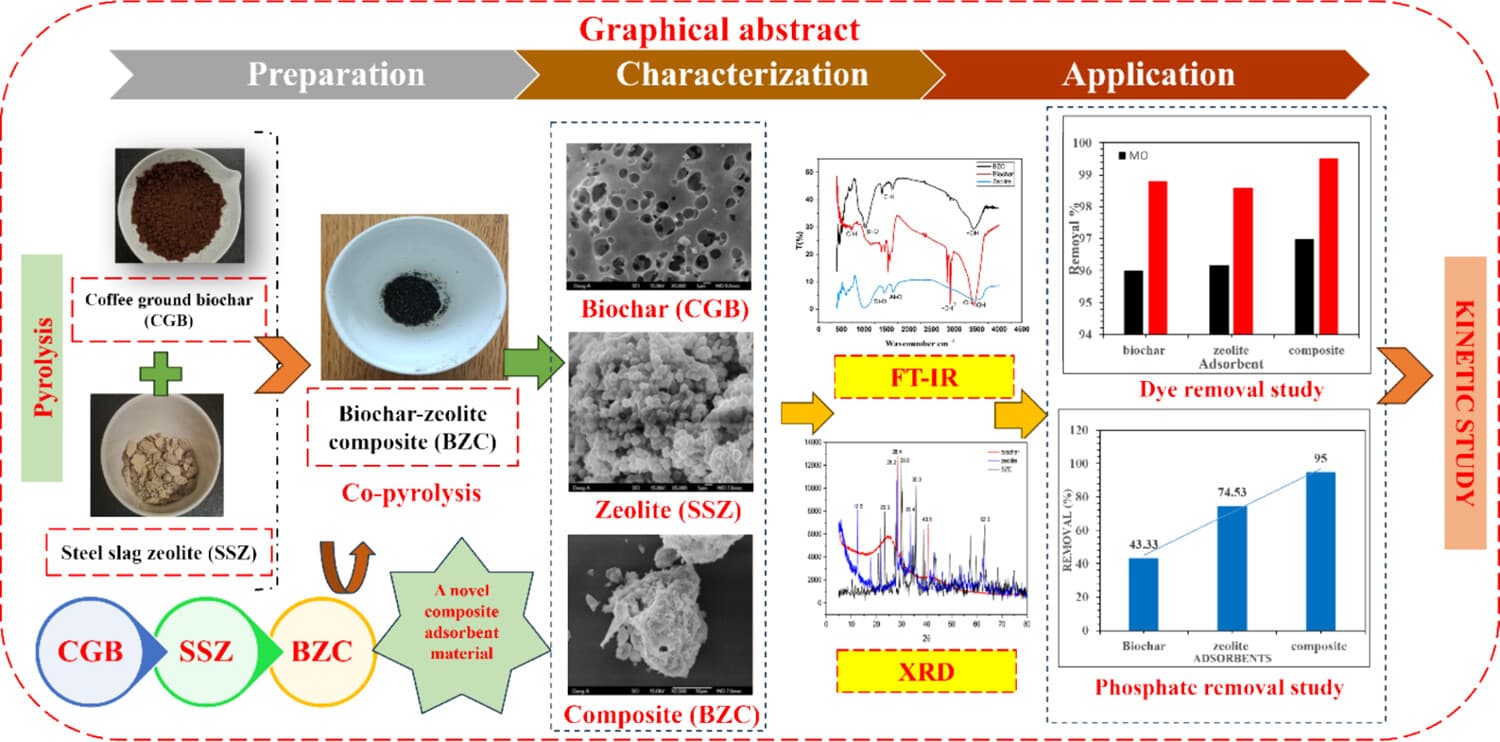
This study investigates the synthesis and characterization of CaO-rich biochar composites produced through the pyrolysis of waste mussel shells and spent coffee grounds at 800 °C. Biochar exhibited a mesoporous structure characterized by an average pore size of 37.7 nm and a surface area of 37.8 m2/g. The composite with a 1:1 mass ratio of mussel shells to coffee grounds (designated as MSBC1:1) has a superior maximum phosphate adsorption capacity of 375.6 mg/g. The adsorption process corresponded to the Langmuir isotherm and pseudo-second-order kinetics, indicating a predominant mechanism of monolayer chemisorption. Phosphate was mostly removed by electrostatic attraction, surface complexation, and the precipitation of hydroxyapatite (Ca5(PO4)3(OH)). Thermodynamic assessments confirmed that the adsorption is spontaneous (ΔG° < 0), endothermic (ΔH° > 0), and driven by entropy. MSBC1:1 composite exhibited strong resistance in a wide pH range (2−12) and ionic strengths (0–0.1 M NaCl), highlighting its practical significance for environmental remediation applications. Furthermore, MSBC1:1 achieved high phosphate removal efficiencies (76.5–97.3 %) in real lake, river, and sewage waters, demonstrating strong potential for practical environmental remediation. The phosphate (P)-laden MSBC1:1 biochar served as an effective slow-release fertilizer, achieving significant improvements in radish (Raphanus sativus L.) growth metrics: a 10.2 % increase in germination rates, a 9.7 % enhancement in plant height, and increases in wet and dry biomass of 28.5 % and 63.1 %, respectively, compared to the control treatment. Furthermore, the use of P-laden MSBC1:1 improved soil pH and reduced salt concentrations compared to raw biochar and the control treatment.